
How to Use Employee Survey Software to Build Ownership and Urgency
Most organizations collect feedback but fail to act on it. Here’s how employee survey software and pulse surveys can help you measure engagement and drive accountability.
Is your organization working hard but still struggling to maintain momentum?
Most organizations don’t lose momentum because people stop working. They lose it because urgency and ownership quietly fade while output still looks acceptable.
Projects continue. Meetings happen. Deadlines are met. But decisions take longer, accountability weakens, and teams start operating without the same level of initiative. By the time leaders recognize the slowdown, performance has already begun to erode.
This is more than a leadership challenge. It’s a long-term performance risk.
Research on long-term IPO survival highlights how critical urgency is to organizational performance. The study found that companies that balanced employee value with urgency were significantly more likely to survive over 20 years. Organizations that emphasized employee satisfaction without maintaining urgency experienced slower decision-making, weaker accountability, and declining long-term performance.
In other words, engagement without ownership and urgency doesn’t drive results.
This is where many organizations struggle. They collect engagement data but measure it too infrequently to detect meaningful change. Annual surveys capture a moment, not a trend. And it’s the trend; the gradual decline in ownership, alignment, and urgency; that predicts performance risk.
Gallup reports that only 1 in 5 employees globally is engaged at work. But engagement is not just about satisfaction. It reflects whether employees feel accountable for outcomes, understand priorities, and act with urgency. These conditions shift continuously, especially during periods of growth, change, or uncertainty.
Employee survey software helps close this visibility gap. Pulse surveys and continuous feedback allow leaders to track ownership, alignment, and urgency over time, identifying early warning signs before they affect execution and performance.
This guide explains how to use employee survey software to measure employee engagement more effectively and turn continuous feedback into stronger ownership, accountability, and team momentum.
Step-by-Step Guide to Building Ownership and Urgency with Employee Survey Software
Ownership and urgency rarely disappear overnight.
The IPO survival research reinforces why these signals matter. Companies that failed to maintain urgency during critical growth periods experienced slower execution and reduced long-term performance.
Employee survey software provides a way to detect these shifts early. Pulse surveys help leaders understand how ownership, alignment, and urgency evolve across teams, making it possible to identify gaps and take targeted action before performance declines.
The following steps outline how organizations can use employee survey software and pulse surveys to measure engagement, strengthen ownership, and maintain urgency across teams.
Overview of the Steps
- Define What Ownership and Urgency Mean for Your Organization
- Conduct Employee Pulse Surveys Using Employee Survey Software
- Measure Energy, Ownership, and Alignment Signals
- Identify Gaps in Ownership and Urgency Across Teams and Managers
- Turn Employee Feedback into Meaningful Action
- Continuously Monitor Engagement Through Ongoing Pulse Surveys
Step 1: Define What Ownership and Urgency Mean for Your Organization

Ownership and urgency reflect both how employees act and how they experience their roles. Ownership shows up in behaviors such as taking responsibility for outcomes, following through on commitments, and solving problems proactively. Urgency reflects how quickly and decisively teams respond to priorities.
Ownership and urgency need to be defined at two levels:
- Behavioral: what employees do in terms of initiative, accountability, and execution
- Perceptual: how employees experience clarity, recognition, and support
Without this distinction, organizations often measure intent but miss execution gaps.
Consider questions such as:
- Do employees feel accountable for outcomes they can directly influence?
- Do teams take initiative without waiting for direction?
- Do employees understand how their work contributes to company goals?
These questions help leaders begin thinking about how engagement can be assessed in ways that reflect real workplace behavior, rather than abstract engagement scores.
Actionable Steps:
- Define behaviors that represent ownership and accountability
- Identify engagement signals such as recognition, clarity of goals, and leadership confidence
- Align engagement indicators with company priorities and strategic objectives
Why It Matters:
Without clearly defined engagement drivers, organizations struggle to evaluate engagement levels consistently. When ownership, recognition, and alignment are clearly defined, employee survey software can capture insights that reflect how employees truly experience their workplace.
Step 2: Conduct Employee Pulse Surveys Using Employee Survey Software
The effectiveness of pulse surveys depends on consistency and focus. High-performing organizations typically follow a fixed cadence, such as weekly or biweekly surveys, with no more than 5 to 10 targeted questions per cycle.
Most organizations rely on annual surveys, but by the time results are reviewed, the opportunity to act has already passed. This is why continuous feedback through employee survey software becomes critical.
Employee pulse surveys provide a more responsive approach by capturing regular feedback on employee motivation, recognition, and alignment with company priorities.
Through employee survey software, leaders can ask employees about topics that directly affect performance and engagement, including:
- Workload and pressure
- Communication from leadership
- Recognition and appreciation
- Alignment with company priorities
Platforms like eePulse make it easier to collect these insights consistently across teams.
Actionable Steps:
- Ask focused, decision-oriented questions that identify what is helping or blocking performance, such as:
- What is slowing your team down this week?
- What would help you deliver better results right now?
- Use employee survey software to run short pulse surveys regularly
- Encourage participation across departments and teams
Why It Matters:
Ownership and urgency can shift quickly. Pulse surveys provide continuous visibility into engagement patterns, helping leaders detect early signals and respond before performance and momentum are impacted. They are most effective when they are designed to inform decisions, not just collect opinions.
Step 3: Measure Energy, Ownership, and Alignment Signals
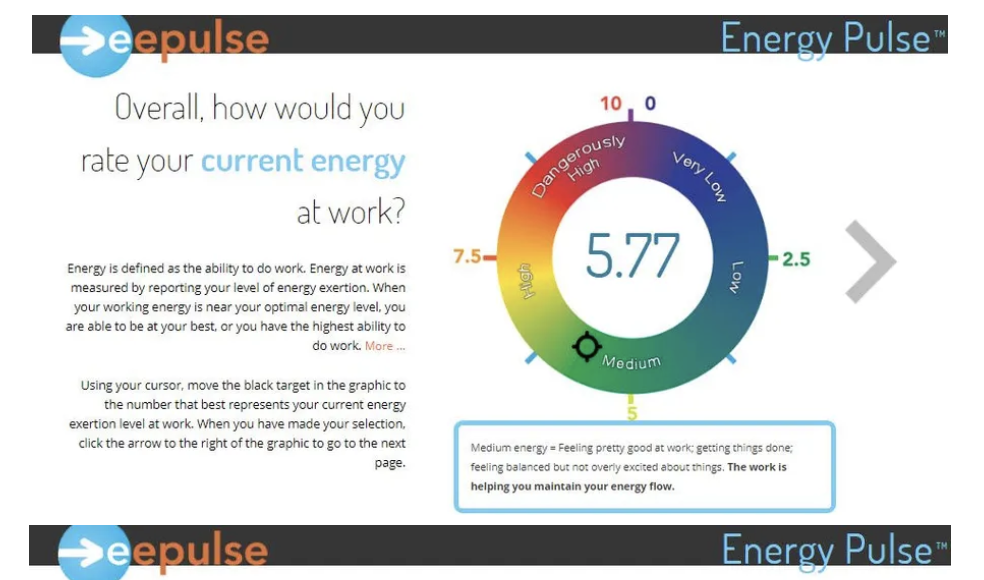
Measuring engagement signals requires distinguishing between leading and lagging indicators. Lagging indicators, such as turnover or absenteeism, reflect outcomes after performance has already been affected. Leading indicators, such as energy, recognition, and clarity, provide early signals of how teams are likely to perform.
Once feedback is collected, the focus shifts to interpreting patterns, not isolated responses. This is where raw feedback becomes actionable insight.
To understand ownership and urgency effectively, leaders should track three categories of signals:
- Energy signals: motivation, enthusiasm, and sustained focus
- Alignment signals: clarity of goals, understanding of priorities, and confidence in direction
- Ownership signals: accountability, initiative, and follow-through
What matters is how these signals move over time. A gradual decline in energy or clarity often indicates emerging issues before they affect delivery or retention.
Platforms like eePulse help structure this analysis by organizing feedback into consistent, trackable signals and surfacing trends across teams and managers, making it easier to interpret what is changing and where attention is needed.
Actionable Steps:
- Track trends over time instead of relying on one-time scores
- Compare signal movement across teams and managers to identify patterns
- Identify early signs of declining energy, misalignment, or reduced owners
- Correlate engagement signals with business outcomes such as delivery timelines or project performance
Why It Matters
Measuring the right signals allows leaders to intervene early, before disengagement affects execution, retention, or critical business outcomes.
Step 4: Identify Gaps in Ownership and Urgency Across Teams and Managers
Identifying gaps means comparing ownership, urgency, and alignment levels across teams, managers, and departments to uncover inconsistencies in performance. Variation across teams is often more informative than overall engagement scores. Averages can mask critical differences in how teams operate under different managers or conditions.
Ownership and urgency rarely exist at the same level across every team. Some groups demonstrate strong accountability and initiative, while others struggle with unclear priorities or declining momentum.
Using employee survey software, leaders can compare engagement patterns across:
- Teams and managers to assess leadership impact
- Similar teams performing comparable work to identify structural differences
- Locations and departments to uncover systemic gaps
This level of visibility helps leaders identify where support or intervention is needed.
Actionable Steps:
- Compare engagement results across departments and leadership teams
- Identify areas where ownership or urgency is declining
- Recognize teams that demonstrate strong ownership
Why It Matters:
When gaps in ownership and urgency go unnoticed, teams begin operating at different speeds and levels of accountability. This misalignment slows execution, weakens coordination, and ultimately impacts overall business performance. Identifying variation enables targeted interventions instead of broad, ineffective engagement initiatives.
Step 5: Turn Employee Feedback into Meaningful Action

Turning feedback into action means using insights from employee survey software to drive focused improvements in ownership, accountability, and alignment.
Surveys alone do not improve engagement. The real challenge lies in acting on feedback with clarity and consistency. When organizations try to address too many issues at once, impact becomes diluted, and outcomes remain unclear.
Effective teams treat survey insights as a decision-making tool. They focus on a few high-impact areas where change will improve performance and alignment.
Managers play a critical role, translating insights into practical actions that teams can see, experience, and respond to.
Actionable Steps:
- Identify 2 to 3 high-impact issues based on engagement trends
- Assign clear ownership at the manager or team level
- Define measurable outcomes to track progress
- Share insights transparently with teams
- Involve employees in shaping solutions
- Communicate actions and progress clearly
Why It Matters:
Organizations that fail to act on feedback risk eroding trust and reducing participation over time. In contrast, consistent and visible action builds credibility, strengthens accountability, and reinforces a culture where employees take ownership of outcomes.
Step 6: Continuously Monitor Engagement Through Ongoing Pulse Surveys
Continuous monitoring is the ongoing process of using employee survey software to track changes in engagement, ownership, and alignment over time, helping leaders understand how team behavior and sentiment evolve.
Engagement is dynamic. As priorities shift and workloads change, employee experience and performance signals move with them. A single data point provides limited value without understanding how those signals change over time.
Effective monitoring focuses on trends and deviations rather than isolated scores. Establishing a baseline for key signals such as energy, alignment, and recognition allows leaders to identify meaningful shifts, whether sudden drops or gradual declines.
Ongoing pulse surveys provide the structure needed to maintain this visibility. They enable organizations to track progress, evaluate the impact of actions, and detect early signs of disengagement or misalignment before they affect performance.
Actionable Steps:
- Establish baseline metrics for key signals such as energy and alignment
- Track trends over time rather than one-time scores
- Monitor deviations to detect early warning signs
- Investigate significant changes to identify root causes
- Adjust actions based on evolving feedback
Why It Matters:
Without continuous monitoring, early warning signs of disengagement often go unnoticed until they impact execution or retention. Ongoing visibility allows leaders to move from reactive problem-solving to proactive performance management, sustaining momentum and alignment across teams.
Pro Tips: Dos and Don’ts
Dos
- Run short pulse surveys regularly
- Ask questions focused on ownership and alignment
- Review engagement insights at the team level
Don’ts
- Don’t collect feedback without acting on it
- Avoid long surveys that reduce participation
- Don’t rely only on annual engagement survey

Key Takeaways
Employee pulse surveys supported by employee survey software help organizations strengthen engagement, accountability, and performance.
- Continuous feedback helps leaders understand how to measure employee engagement more effectively
- Pulse surveys reveal early signals of declining energy or motivation
- Engagement insights strengthen ownership and accountability
- Leadership actions based on feedback improve alignment and performance
- Regular engagement measurement helps organizations maintain momentum
Next Steps: Turn Continuous Feedback into Consistent Execution
Collecting feedback is only the starting point. The advantage lies in how effectively that insight is used to guide decisions and improve performance over time.
Begin by evaluating how engagement is currently tracked and where gaps in visibility exist. This could include limited insight into team energy, unclear alignment with priorities, or inconsistent ownership across managers.
A more effective approach relies on continuous input through pulse surveys designed to capture the drivers of performance, not just sentiment. Signals such as clarity, recognition, and confidence provide a more actionable view of how teams are operating.
eePulse supports this by enabling organizations to tailor surveys to their context, incorporate employee-driven inputs, and analyze patterns across energy, alignment, and ownership.
Over time, this creates a system where insights translate into clearer priorities, stronger accountability, and more consistent execution across teams.
Start building stronger ownership and urgency across your teams with employee survey software designed for continuous feedback and real-time insights.
FAQs
Q1. Will employees give honest feedback in engagement surveys?
Yes. Anonymous surveys and consistent follow-through help employees feel comfortable sharing honest feedback. Reliable employee survey software ensures responses remain confidential.
Q2. Will frequent pulse surveys cause survey fatigue?
Not if surveys are short and focused. Pulse surveys typically take only a few minutes and help organizations continuously understand how to measure employee engagement without overwhelming employees.
Q3. Can engagement survey results really be trusted?
Yes. Reliable employee survey software analyzes patterns across teams and time periods, helping leaders identify meaningful engagement trends rather than isolated opinions.
Q4. What if surveys reveal uncomfortable issues about leadership or culture?
That insight is valuable. Identifying issues early allows leaders to address problems before they affect morale, performance, or retention.
Strengthen Ownership and Improve Team Performance with Employee Survey Software
Use employee survey software and pulse surveys to measure engagement more effectively and turn feedback into consistent execution.
- Define ownership and urgency through clear behaviors
- Use pulse surveys to capture real-time signals
- Track leading indicators to spot early risks
- Compare teams and managers to identify gaps
- Act on feedback with focus and consistency
Track key signals, act early, and drive stronger ownership and execution with eePulse’s employee survey software.